What it is
A field of ten million cells. You send balls into it; they bounce, bore and wear the rock down, and every cell they break pays out pixels you spend on more balls and better ones. Harder rock takes longer and pays more.
Buried in the field are pictures. You do not place them and you cannot buy them — they are down there from the moment the field is made, and the only way to see one is to dig the rock off it. The Gallery keeps what you recover, and you can zoom right into it.
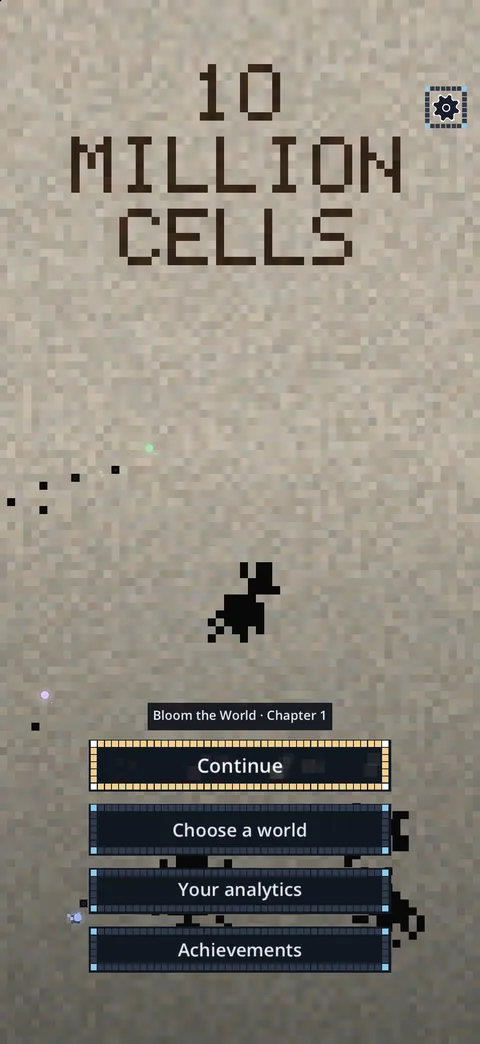
Home picks up where you left off. 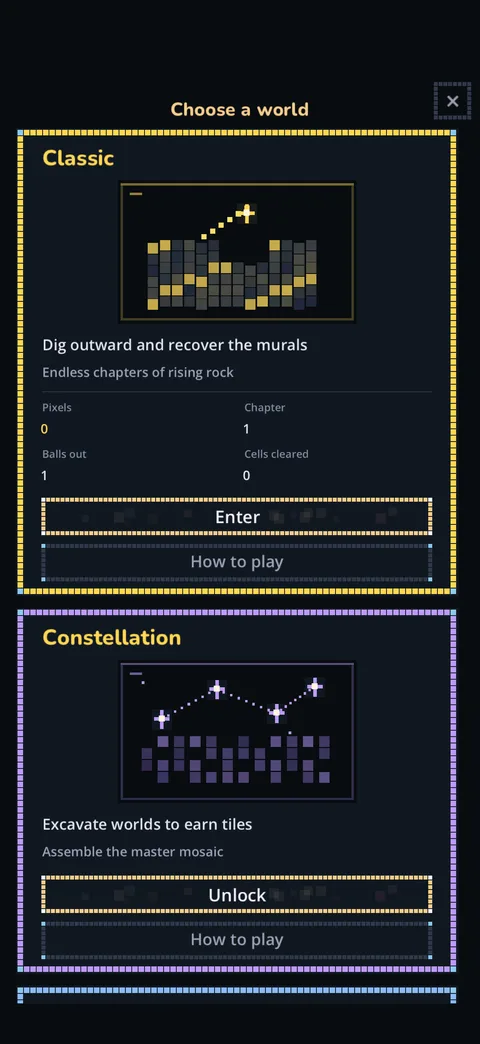
Five worlds, each with its own goal. 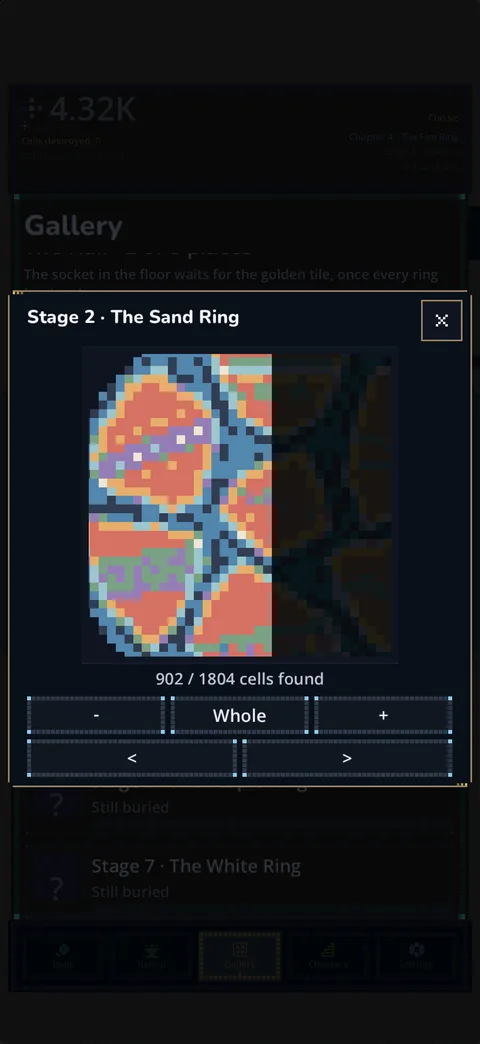
A picture, half dug out.
Five worlds
- Classic — dig outward and recover the murals. Endless chapters of rising rock. Free.
- Constellation — excavate worlds to earn tiles and assemble the master mosaic.
- Depths — dig down instead of out, and reach the bottom of each depth.
- Bloom & Rot — brown patches make the rock tougher. Dig them away and leave green trails behind.
- Bloom the World — every cell you break turns green. Each ring asks for something different: seeds to reach, a path to cut, or simply more green.
The eleven balls
Each one has a job and a limit, and its card says both.
- Drifter — Falls, bounces, wears the field down. Patient.
- Bloom — Opens a soft crater wherever it lands.
- Lance — Crosses open ground on one straight pass; surviving rock reflects it.
- Splitter — Becomes two, then four, then quiet again.
- Spore — Poisons the cell it touches, and the poison eats its way on.
- Prism — Every bounce sends it somewhere it has not been.
- Echo — Heavy and unhurried. What it touches, it takes.
- Creeper — Holds on to the rock and works its way along the face.
- Plumb — Falls toward the middle and pulls toward valuable rock. Digs a curve, and comes home.
- Electric — Drifts slowly and throws lightning at the rock around it.
- Mason — Takes nothing. Builds bricks the rest of the fleet is paid to break.
How you play it
- Orders you draw. Hold on empty ground to send a ball, put a Mark and the fleet goes to it, or draw a line and the fleet spreads along it.
- Standing orders. Eager hits harder and moves faster, Patient is far better on dense rock, Watchful reveals more ground around every opening. Each says exactly what it costs.
- Chapters that keep going. Finish one and the next is a fresh field on different ground, with a small purse carried over. From chapter thirteen each ground also gets a condition — rich seams, dense rock or loose rock — so later chapters do not just repeat earlier ones.
- Away time that is honest. The field does not dig itself while the game is closed. The fleet earns pixels instead: full rate for two hours, longer as you upgrade Nightwork, then a quarter rate up to a day.
Made to be read
English, Deutsch, Français, Español and 日本語. Three text sizes that reach every screen, a reduced-motion setting, and labels for VoiceOver and TalkBack on the game's own controls.
What costs money, and what does not
Classic is free and does not end. Constellation, Depths, Bloom & Rot and Bloom the World can each be bought on their own, or all four together. Inside a world nothing is sold: every ball, upgrade and picture is earned by digging.
A short ad can play when a chapter ends — never more than one every fifteen minutes, never in the middle of play. Remove Ads switches them off for good. The terms list everything that is on sale.
Your data
Your game is backed up to the cloud automatically, under an account with no name. Usage analytics has its own switch in Settings; in the EU, the EEA, the UK and Switzerland it starts off. The privacy page lists what is sent and how to delete it, and Settings has Delete account.
Get it
Questions
Is 10 Million Cells free to play?
Classic is free and endless. The other four worlds can be bought one at a time or together. Inside a world, every ball, refinement and picture is earned by playing.
Does it have ads?
A short ad can play when a chapter ends, never more than one every fifteen minutes and never in the middle of play. Remove Ads turns them off for good.
Does it dig while the app is closed?
No. The field only changes while you watch it. While you are away the fleet earns pixels instead: at full rate for two hours, longer as you upgrade Nightwork (up to ten hours), then a quarter rate up to a day.
Can I move my game to another phone?
On iPhone and iPad, sign in with Apple in Settings and restore on the other device; the game shows both saves side by side before replacing anything. Every world and chapter travels together. On Android your game is backed up to the cloud, but moving it to another device is not possible yet.
What happens when a chapter ends?
You start a fresh field of ten million cells on different ground, with a small purse of pixels carried over from the chapters you finished. The old chapter stays where you left it and you can go back to it. Chapters do not run out.